
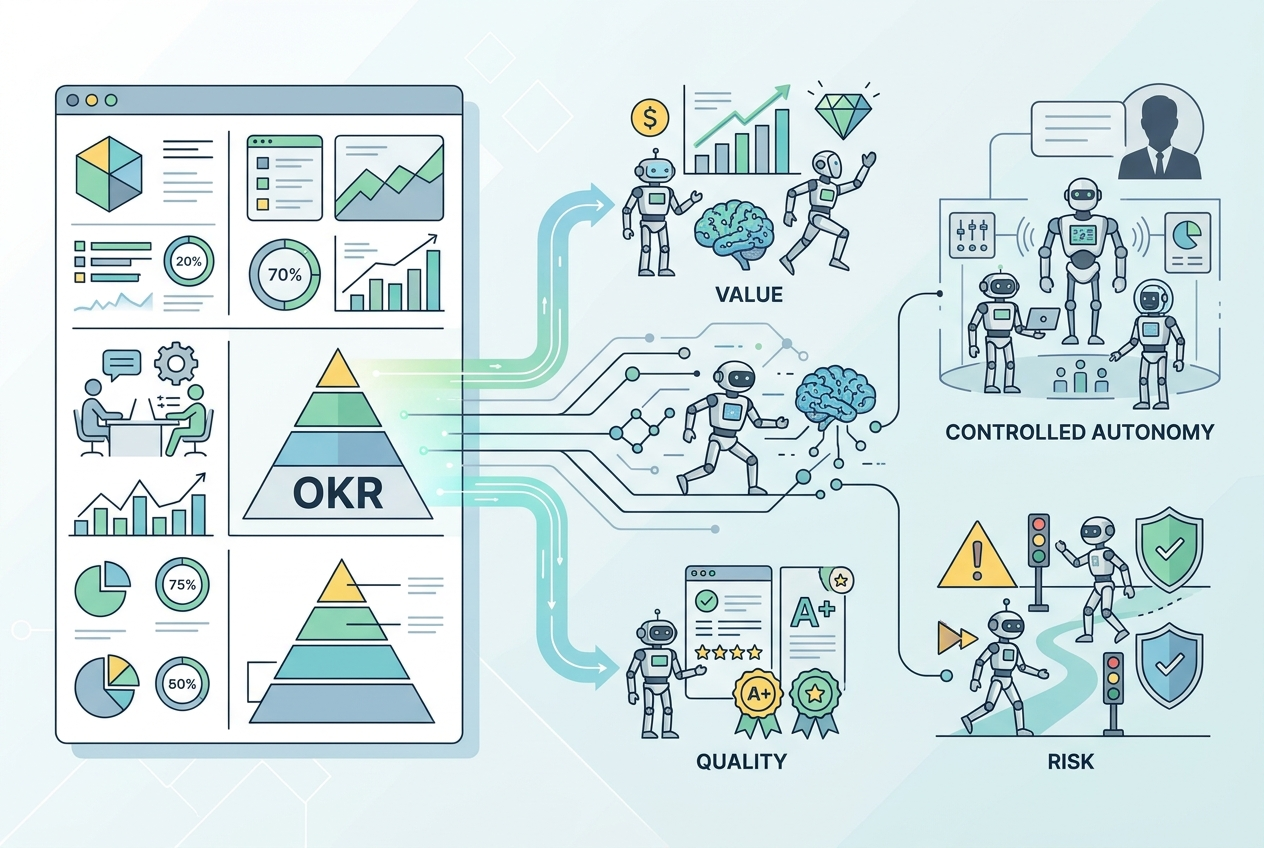
What is an OKR?
OKR stands for Objectives and Key Results. It is a management framework that helps an organization answer two simple questions: What do we want to achieve? And how will we know when we have achieved it?
An OKR combines a qualitative, clear, and inspiring Objective with several Key Results, which must be measurable and verifiable. An OKR is not a list of tasks: it defines an outcome that should deliver meaningful impact.
Example: Objective: “Transform our customer service into a fast, personalized, and reliable experience.” Key Results: Reduce average response time by 30%; increase first-contact resolution to 90%; achieve a customer satisfaction rating of ≥ 4.5/5.
What does Agentic AI bring to the table?
Generative AI produces content and responses; agentic AI adds the ability to take action. An AI agent can interpret an objective, plan steps, use tools, access data, coordinate with other agents or systems, and execute actions within defined rules and permissions.
This creates both an opportunity and a responsibility: OKRs can evolve from measuring only the performance of people and processes to also measuring the value, controlled autonomy, quality, and risks associated with AI agents.
The Agentic OKR: from “doing” to “achieving”
A best practice is to frame the OKR around the business outcome the technology is intended to achieve, rather than around the technology itself (“deploying an AI agent”).
| Weak aproach | Value-oriented OKR | Agentic control |
| Implement a chatbot | Improve customer service | Quality, traceability, and human escalation |
| Create a procurement agent | Reduce procurement costs and lead times | Spending limits and authorization |
| Automate reporting | Reduce reporting time | Verified sources and supporting evidence |
Examples of OKRs using Agentic AI across industries
Banking and financial services
Objective: Improve customer service and financial management through secure and supervised AI agents.
- Reduce average inquiry resolution time by 35%.
- Achieve ≥ 90% accuracy in responses to automated cases.
- Ensure that 100% of sensitive operations remain subject to human authorization or predefined rules.
- Log 100% of relevant decisions and actions for auditing purposes.
Industry and manufacturing
Objective: Leverage AI agents to anticipate issues and improve operational efficiency.
- Reduce unplanned downtime by 20%.
- Increase Overall Equipment Effectiveness (OEE) by 15%.
- Achieve ≥ 95% relevant alerts versus false alarms within the defined threshold.
- Maintain traceability of the data, recommendations, and actions performed by AI agents.
Healthcare
Objective: Free up clinical time through agentic AI without compromising safety or quality.
- Reduce administrative time per healthcare professional by 25%.
- Achieve ≥ 95% compliance with defined controls for automated cases.
- Escalate 100% of cases classified as critical or out of scope to a healthcare professional.
- Maintain traceability of data sources, recommendations, and human oversight.
Retail and e-commerce
Objective: Personalize customer interactions and improve conversion rates through AI agents.
- Increase conversion rates by 10% in target customer segments.
- Reduce customer service response time by 30%.
- Resolve ≥ 85% of inquiries within the authorized scope.
- Reduce incidents caused by incorrect or outdated information by 15%.
Public administration
Objective: Simplify public services through trustworthy and transparent AI agents.
- Reduce the average processing time for selected administrative procedures by 30%.
- Achieve ≥ 90% citizen satisfaction.
- Ensure that 100% of decisions legally requiring human intervention are reviewed by a person.
- Maintain auditable records of data, rules, actions, and escalations.
Education
Objective: Personalize learning and reduce administrative workload through AI agents.
- Reduce teachers' administrative workload by 25% in selected processes.
- Increase active student engagement by 15%.
- Achieve ≥ 90% compliance with established data protection and responsible use policies.
- Maintain human oversight by educators in assessments or high-impact decisions.
Cybersecurity / Security Operations Center (SOC)
Objective: Increase detection and response speed through coordinated AI agents.
- Reduce the Mean Time to Resolution (MTTR) for selected incidents by 40%.
- Increase the coverage of automatically investigated alerts by 25%.
- Ensure that ≥ 95% of automated actions remain within authorized playbooks.
- Automatically escalate critical incidents to a human security analyst.
Small and Medium-Sized Enterprises (SMEs)
Objective: Turn agentic AI into measurable productivity gains without losing control.
- Automate at least 5 repetitive processes with measurable economic impact.
- Reduce the time spent on selected administrative tasks by 20%.
- Achieve a positive ROI on prioritized agentic AI initiatives.
- Establish an inventory of AI agents, responsible personnel, permissions, data, and controls.
NOTE: The percentages in the examples above are illustrative. Each organization should establish its baseline, success threshold, accountable owner, measurement frequency, and supporting evidence before setting the final targets.
A New Dashboard: OKRs + AI Governance
In agentic AI, achieving the desired outcome should not be enough. It is also necessary to demonstrate that it has been achieved safely, legally, ethically, with full traceability, and to the expected quality standards. Therefore, it is proposed to add a second dimension to the traditional OKR framework: the controlled “how.”
- Value: What business, social, or public benefit do we achieve?
- Quality: Is the outcome accurate, consistent, and fit for purpose?
- Risk: What could go wrong, and what would the impact be?
- Autonomy: What can the AI agent do independently?
- Oversight: When should a human intervene?
- Traceability: Can we reconstruct which data, rules, and actions led to the outcome?
- Security: Are identities, permissions, tools, and data properly controlled?
- Compliance: Can we provide evidence for audits or regulatory requirements?
Conclusion
Agentic AI has the potential to transform organizations because it goes beyond simply providing responses: it can take action. For this very reason, objectives must be more clearly defined, and outcomes must be more measurable and auditable.
The challenge is not to deploy large numbers of AI agents, but to ensure that they help achieve real business objectives within clearly defined boundaries and under clear accountability.
Technology without methodology is a body without a brain
And in agentic AI, a well-defined OKR can be part of an organization's brain.