In previous posts, ISO standards relating to the governance, management and quality of AI (I), (II) and (III), we present the standards that address topics relating to the governance and management of AI, as well as data quality.
On this occasion, we will be looking at the standards [1] relating to the quality of software in AI systems (AIS).
Software life cycle
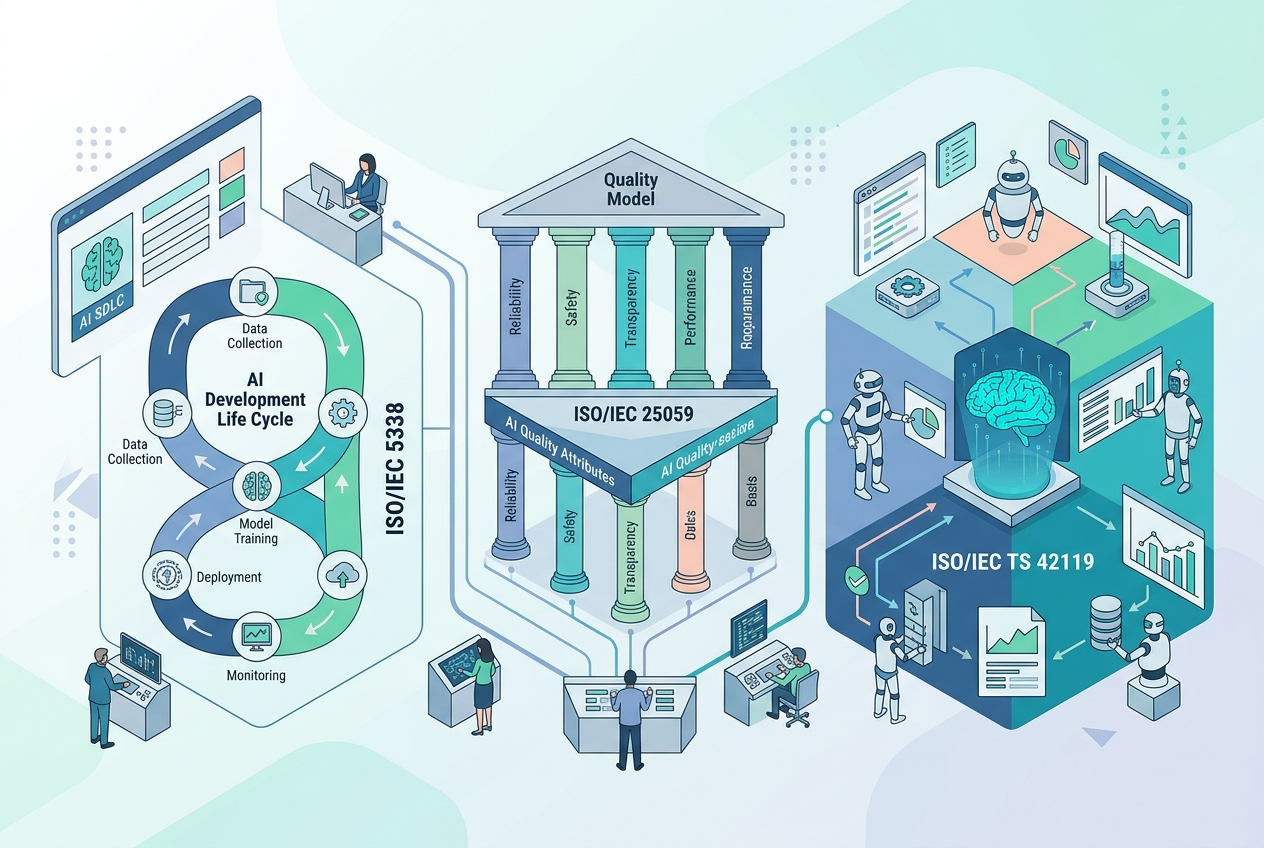
ISO/IEC 5338 Information technology — Artificial intelligence — AI system life cycle processes
This standard establishes an international framework for the life-cycle processes of AI systems, defining a common set of processes, activities and tasks for engineers, developers and organisations, extending and adapting traditional software life-cycle processes (such as those defined in ISO/IEC/IEEE 12207).
This draft standard provides a PAM (Process Assessment Model) specifically for AI, enabling the objective determination of a company’s level of capability and maturity when developing, deploying or using Artificial Intelligence systems. It should be noted that, for organisations interested in this topic, frameworks of this kind already exist, such as the MMSIA, which is also based on the ISO/IEC 33000 family of standards for process assessment and ISO/IEC 5338, which provides developers of AI systems with a structured tool for the continuous improvement of their development lifecycle processes, thereby enhancing the reliability and effectiveness of AI applications.
Quality models
This technical specification, which forms part of the ISO/IEC 25000 family of standards, known as SQuaRE (Systems and Software Quality Requirements and Evaluation), acts as a methodological bridge between traditional software engineering and AI engineering. ISO/IEC TS 25058 reinterprets the classic quality characteristics of SQuaRE and defines how they should be specifically measured in AI systems, whilst standardising a rigorous workflow for carrying out the quality assessment of any AI product or system.
This standard formally establishes the reference quality model for AI systems, extending the general software quality model (ISO/IEC 25010) with specific characteristics and sub-characteristics designed to capture the risks, data dependencies and probabilistic behaviours inherent in AI systems. It should be noted that certifications relating to this standard already exist.
The technical report ISO/IEC TR 42106 provides a methodological framework for differentiated benchmarking of the quality characteristics of AI systems. The aim is to measure how critical quality characteristics (as defined in the ISO/IEC 25059 standard) perform under different operational contexts, load profiles and risk domains.
Testing
This Technical Report is part of the ISO/IEC/IEEE 29119 series, the global standard for software testing. Part 11 is devoted exclusively to providing guidelines for the testing of systems based on Artificial Intelligence.
ISO/IEC TR 29119-11 addresses the issue that AI systems (particularly Machine Learning systems) are probabilistic and stochastic. There is no static code to audit, but rather a model that learns from data. Consequently, the system’s behaviour can be unpredictable, rendering traditional testing methods insufficient for validating accuracy, bias or security.
ISO/IEC TS 42119-2 Artificial intelligence — Testing of AI Part 2: Overview of testing AI systems
The ISO/IEC TS 42119-2 document is a Technical Specification which provides an overview of testing for AI-based systems, defining a multidimensional spectrum of critical characteristics that must be tested: Statistical Functional Performance, Robustness and Resilience, Fairness and Bias Mitigation, Explainability and Transparency, etc. It emphasises that AI testing is not an isolated phase at the end of development, but rather provides a framework for integrating testing activities on an ongoing basis.
Part 3 examines the analytical methodology of Verification and Validation (V&V) in greater depth, and sets out guidelines for structuring a V&V case that brings together mathematical, statistical and engineering evidence to demonstrate the reliability of an AI system.
ISO/IEC AWI TS 42119-7 Artificial intelligence — Testing of AI Part 7: Red teaming
This ISO/IEC AWI TS 42119-7 project will provide the first standardised international framework for planning, conducting and reporting Red Teaming exercises specifically designed to uncover critical vulnerabilities, physical/logical security risks and ethical misalignments that conventional automated testing methods fail to detect.
ISO/IEC AWI TS 42119-8 will establish the first international framework for quantitatively and qualitatively measuring, assessing and certifying the quality, consistency and security of textual responses generated by systems based on prompts.
[1] The summaries of the content presented in this post have been provided directly by GEMINI and reviewed by I2SC.