In previous posts, ISO standards relating to the governance, management and quality of AI (I), (II), (III), and (IV) we present the standards that address topics relating to the governance and management of AI, as well as data quality and certain aspects of the quality of AI systems, with a focus on software.
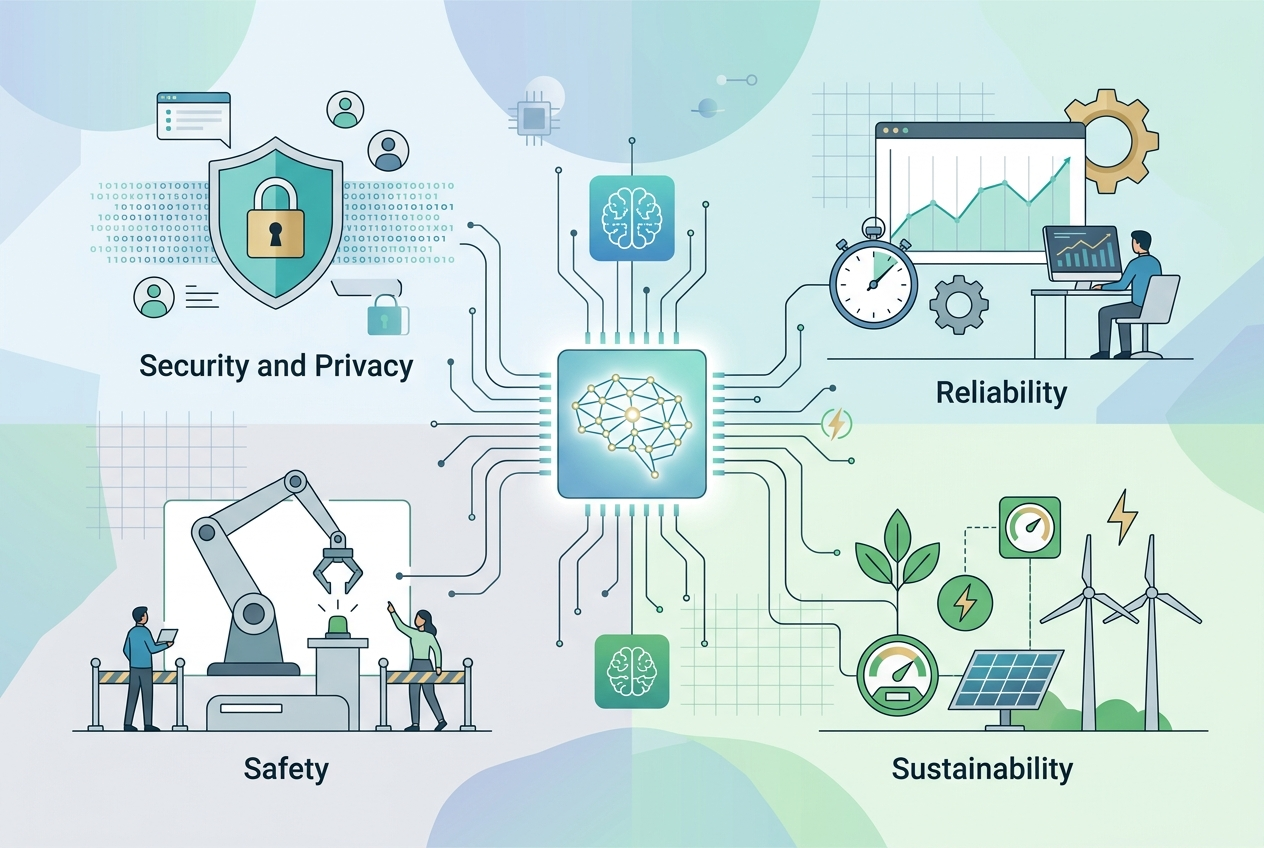
On this occasion, we will be looking at the standards [1] relating to other quality characteristics of AI systems.
Security and privacy
ISO/IEC TR 27563 Security and privacy in artificial intelligence use cases — Best practices
This technical report compiles and analyses real-world use cases of AI to identify the associated security and privacy risks, and uses these to distil a set of organisational and technical best practices. It also highlights the need to update the existing Information Security Management Systems (ISMS) within the ISO/IEC 27001 family of standards to cover AI.
This is a specific and systematic guide to identifying, assessing and mitigating security threats targeting Artificial Intelligence systems, offering a formal catalogue of security controls and technical countermeasures that organisations must implement to protect the integrity, confidentiality and availability of their AI/ML pipelines.
ISO/IEC FDIS 27091 Cybersecurity and Privacy — Artificial Intelligence — Privacy protection
It is a technical standard specifically focused on privacy protection in AI systems, which translates general data privacy principles (such as those set out in ISO/IEC 29100 and regulations such as GDPR) into privacy controls and engineering applicable to the unique challenges posed by Machine Learning (ML) and AI data architectures.
This technical specification will provide practical implementation guidance for the de-identification of data used specifically for the training and validation of machine learning (ML) models.
Functional safety
ISO/IEC TR 5469 Artificial intelligence — Functional safety and AI systems
This technical report analyses the intersection between Functional Safety and the non-deterministic properties of AI systems, identifying the methodological challenges posed by AI in safety analyses and providing guidelines for mitigating the risks of systemic failures in environments where human life or the environment depend on software.
ISO/IEC CD TS 22440-1 Artificial intelligence — Functional safety and AI systems
The ISO/IEC TS 22440-1 standard is the first international standard designed to unify the traditional discipline of Functional Safety (based on IEC 61508) with the adaptive, probabilistic and data-driven nature of Artificial Intelligence and Machine Learning (ML). Its aim is to enable the certification and safe deployment of AI in highly critical sectors such as autonomous robotics, medical devices, the automotive industry and industrial control systems.
ISO/IEC CD TS 22440-2 Artificial intelligence — Functional safety and AI systems Part 2: Guidance
This technical specification is structured to address the ‘how’ of functional safety in AI, focusing on the mitigation of systemic failures through three guiding pillars: Examples of Practical Application, Guidance on the Selection of V&V Methods, and Secure Architectural Design Patterns.
Whilst Part 1 defines the mandatory regulatory requirements and Part 2 provides engineering guidance and architectural patterns, ISO/IEC TS 22440-3 focuses exclusively on Application Examples, providing detailed end-to-end case studies that illustrate how to implement the entire conceptual framework set out in the previous parts in practice within real-world industrial scenarios.
Sustainability
This standard structures the analysis of environmental sustainability using the principles of Life Cycle Assessment (in accordance with standard ISO 14040), and identifies four critical dimensions in which AI systems have a direct environmental impact: Energy Consumption and Carbon Intensity, Water Consumption (Water Footprint), Resource Depletion and Waste.
The ISO/IEC CD TS 42111 technical specification provides general guidelines for the development and deployment of lightweight AI systems, which are specifically designed and optimised to operate under severe resource constraints.
The aim of this technical specification is to reduce computational costs, energy consumption and the time required to achieve model convergence, whilst promoting engineering practices that maximise hardware performance and data utilisation without compromising the final quality of the model.
Reliability
The ISO/IEC WD TS 25570 technical specification aims to establish the methodological framework for assessing the reliability of AI systems. Unlike traditional software quality, reliability in AI is probabilistic. Standard 25570 seeks to resolve the ambiguity surrounding how we measure whether an AI system ‘operates reliably’ under different operating conditions.
[1] The summaries of the content presented in this post have been provided directly by GEMINI and reviewed by I2SC.